Four steps. Four weeks.
Structured interviews
Syntrii advisors interview stakeholders across the functions in scope — operator, technology and marketing — grounding the assessment in how the business actually runs, not how the org chart says it should.
Client self-assessment
The client’s own team scores the same standard, independently — capturing where they believe they stand today, with both quantitative and qualitative feedback.
Independent Syntrii scoring
Syntrii scores the same value driver trees independently — the same rigour applied in a detailed strategic review of an integrated resort or gaming operation.
One findings report
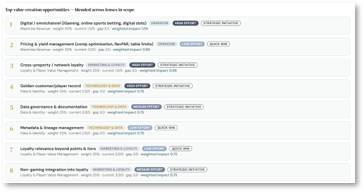
A single composite score and all functional scores in scope; every sub-lever ranked into one prioritised roadmap of quick wins and strategic initiatives, with suggested actions to achieve alignment across all functions.
Steps 02 and 03 assess the same value driver trees against the same standard — once by the client, once by Syntrii, independently. The gap between the two scores is itself a finding. Where a business believes it is stronger than the evidence supports, that is where value is leaking unnoticed; where it is harder on itself than the evidence warrants, there is usually capability already in place that is not being used.
A single composite score
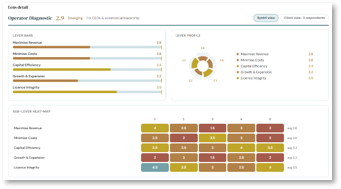
Plus the individual functional scores for every lens in scope, on a standard that can be re-run later to show movement.
Every sub-lever ranked
Not a heat map with no next step — each sub-lever placed in order of what it is costing you now.
One prioritised roadmap
Quick wins separated from strategic initiatives, with the suggested actions to bring the functions into alignment.
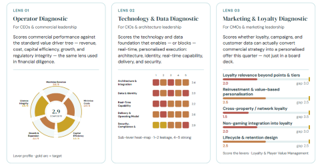
Every lens is scored independently against the same value driver trees, then read against the client’s own self-assessment. The gap between the two is the finding — it locates where the operating assumption and the operating reality have come apart, and ranks what that is costing now.